
Every Boy Needs a Pet

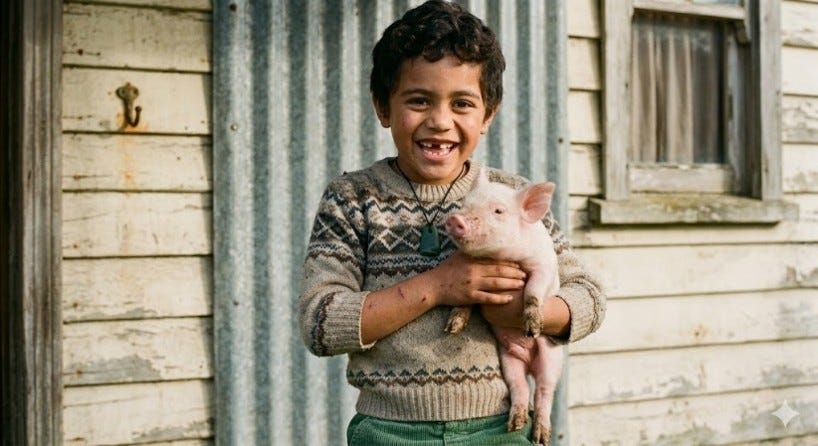
Rachael flopped into a chair, slumped so that her head was level with the table, and sat there scowling out at the world.
‘Good morning, Rachael,’ said Joe.
He’d been worrying. It was the last of everything, and there’d been a bit of a fight over the little knob of butter in the dish. Eventually Tim had just snatched it up and shoved it in his mouth and grinned while it dribbled down his chin. Now here was Rachael, tipping more than her share of cornflakes into her bowl. Tim had just grabbed Tamati’s slice of bread without asking. But that was okay, because Tamati was running a fever and didn’t feel much like eating. Joe shared out the last of the milk, and they’d have to have the cornflakes without sugar. Joe himself was making do with a glass of water, but it was obvious that today he’d have to do some shopping.
“Bella’s got, like, a new i-Phone Air!” said Rachael. She was slouched forward now over her bowl, her lip turning down into something resembling a grimace at the thought of the fortunate Bella. She slurped half-heartedly at a spoonful of cornflakes.
“Has she?” said Joe. “What’s that, then?”
“An i-Phone! They’re awesome!” Joe looked at her blankly, and now the scowl transformed into a sneer. “Oh my God! Don’t you even know anything?” she said. “Do you even know what broadband is? Do you even know what wireless means? Uh!” She made her disgusted sound, shuddering at the thought of Joe’s ignorance.
And Joe decided he didn’t know what wireless was, because a wireless was what his grandfather used to call his old valve radio, and he was certain Rachael wasn’t talking about one of those.
“Eat your cornflakes,” he said.
Rachael looked suddenly repelled by the idea. “No sugar! It’s just really annoying!” she said and pushed the plate away. She was stuck on the idea of Bella. “Bella gets, like, twenty dollars a week! And she doesn’t even have to do anything! I mean like work and stuff! Like, I have to wash the dishes.”
“Yes, well we don’t have a spare twenty dollars, I’m sorry,” said Joe.
“Uh!” The disgusted sound again. “Whatever!” She strutted off down the hallway, and then Joe heard the phone, numbers being punched in. “’Sup, bee-atch?”
He felt a surge of anger. He felt like going after her, explaining to her how hard it was to make ends meet; make her come back and eat the food she’d just put on her plate. Instead, he swallowed his anger, pulled the plate towards him and slowly began spooning the sodden cornflakes into his mouth while he listened to Rachael’s voice, a hostile mumble from down the hallway.
He’d told Tamati to stay in bed, but now he could hear him getting ready for school. It was “Hero Day”, where the kids got to dress up as their favourite hero, and it had been Tamati’s idea to go as Tama Iti.
“Epic!” Rachael had said to him. “You go to school with, like, a moko, the other kids’ll think I’m, like, stoopid! ’Cause, like, I’ve got a stoopid brother! Go as Spiderman! Spiderman’s, like, cool!”
How is a spider web on your face better than a moko? Joe had wondered. But Tamati had already drawn half a moko on his face with a Sharpie by the time Joe had caught him. They’d had to borrow some methylated spirits from old Mrs Anvil down the road to get it off. So, then Tamati had decided on a more conservative approach. He was going as Batman, he said. Joe had helped him to make a cape out of an old T shirt, and he’d used the sleeve and a rubber band to make a sort of mask.
“Is that, like, a thing?” asked Rachael when she saw the costume. “It sucks!” But it had been the best Joe could do with an old T shirt, a rubber band and a bit of sticky tape.
And now, here was Tamati trying to tie the cape around his neck.
“Hang on,” said Joe, “hang on. “You can’t go to school when y’re crook,” he said. “Y’ll give the other kids the bug, eh?”
“But it’s Hero Day, Dad!” whined Tamati, tears starting in his eyes.
“Don’t matter!” said Joe firmly. And he left the boy to sulk for a bit.
Really, he should put him to bed. That’s what Joe’s mother would have done with him. Put him to bed and make him eat soup. But they’d have to go out. They had no choice. Joe had a job interview at nine, and if he didn’t do some shopping they’d have nothing to eat.
He’d got Tim and Rachael off by eight-thirty, and then headed out the door, with Tamati still whining about Hero Day. Half an hour to get to the job interview. Joe got Tamati into the old Toyota, buckled him up, slipped the key into the ignition and crossed his fingers. He hadn’t used the car for a few days, it had been a cold night, and he figured there was at best a fifty-fifty chance it would start. He turned the key and there was a click from somewhere under the bonnet. Another turn, another click.
“Damn!” Joe thumped his fist down on the steering wheel. He’d known for weeks that the car needed a new battery, but even a re-cycled one would cost him a hundred and fifty bucks. That was more than a week’s housekeeping budget!
“Come on, son,” he said. “We’ll have to push.”
Tamati looked flushed from the fever, and he was still unhappy about missing Hero Day. He tumbled out of the car and slouched around to his usual position at the back, while Joe rolled down the driver’s window so he could steer and push at the same time.
“Heave!” said Joe, and they both applied their weight to the car. Slowly it began to trundle down the driveway, gradually picking up speed as it went. As it got near to the road, Joe jerked the door open, jumped into the driver’s seat, depressed the clutch, slipped the gear shift back into second gear and let the clutch pedal out with a rush. The motor coughed once, spluttered, and then died.
“Damn!” he said. Now they were out on the roadway. “Let’s have another go!” he yelled to Tamati.
So, they pushed again, and this time when Joe released the clutch the motor roared into life.
“Come on, son!” he called through the open window.
But as he let the motor fade towards an idle he could hear Tamati whimpering at the back of the car. He opened the door and went around to the back. Tamati was on the ground. He’d slipped and skinned his knee. Joe knelt by the boy and put an arm around him. He examined the wound. He knew he should bathe it with disinfectant. Get out any dirt and minimise the chance of infection. But he had the job interview. He’d do it later.
“Not too bad, son,” he said. “Come on!” He brushed the tears from the boy’s cheeks, and could feel the slight fever burning there.
He was helping Tamati back into the car when the motor died again.
“Damn! You stay there, son. I’ll see if I can get ’er going again.”
Now he could smell petrol. The motor was flooded, and each time he pushed and released the clutch it would turn over a few times but refused to kick into life. Joe could see that bloke at number eleven watching through his curtains. Old Mrs Turpin was staring at him in open-mouthed wonderment from her front porch, some sort of floral hat on and a gardening fork held at her side, so that she looked like and aging Neptune.
It was five to nine, and he still hadn’t got the thing started when a council truck droned around the corner. Joe had been pushing the Toyota up and down the cul de sac for almost half an hour. He was drenched with perspiration and he was exhausted. The driver of the truck leaned out the window.
“Need some help, bro?”
“Yeah! That’d be good!” said Joe.
Four men climbed out of the truck, and while Joe sat in the driver’s seat ready, they pushed. They’d only gone a few metres, and the car was travelling almost as fast as it would under its own steam. Joe dropped the clutch, and after a few metres more the car backfired, belched a wad of black smoke, and the motor roared into life.
“Thanks!” Joe yelled out the window. He gave them the thumbs up, and off up the road they went, a thin wisp of oil vapour trailing behind them. Nine o’clock. “Damn!” said Joe. “Be late for that appointment now!”
He glanced over at Tamati, who was sitting in his own private pool of misery. Joe felt a wave of pity wash through him.
“Be oright, son!” he said. “Get you something special when we go shopping, eh?”
Abbott Brothers. 29 Workman Way. Joe had written the address down on a scrap of paper. The job had been advertised as a digger operator/labourer. Joe could certainly labour, and he’d been operating machinery since his early days, back on the farm. Tractors; bulldozers; and he’d done a bit of time on diggers. He’d soon pick it up. By the time he found Abbott Brothers’ yard it was twenty past nine. He quickly checked the car over, making sure that there was nothing Tamati could hurt himself with: key out of the ignition; wheels turned into the kerb, so the car wouldn’t move if the handbrake was released; cigarette lighter removed; windows down a bit for air.
“You stay here, son!” he said. “I shouldn’t be too long. There’s books there for you to read. Okay?”
“’Kay.” The boy really looked like he should be home in bed.
Abbott Brothers’ office was nothing flash, but all Joe wanted was a job. He tapped on the door, and walked in. A young woman of about twenty sat behind a desk in a small, grubby room. She was partially obscured by a large computer screen, and was giggling into a cell phone. She glanced up at Joe, then swivelled her chair away from him and continued her conversation in hushed tones. Several minutes passed before she clicked the phone off and turned back to him.
“Can I help you?” she asked, the smile gone from her face now.
“I’m here to see Mr Abbott,” said Joe.
“Which Mr Abbott?”
“Oh,” said Joe. “Dunno. It’s about the job.”
“That’ll be Andrew,” she said. “Do you have an appointment?’
“Yeah. I’m a bit late, eh?”
“I’ll see if he’s in.”
She tapped something into the keyboard in front of her, then got up and walked through to another office. Joe could hear voices muted through the closed door, before the young woman came back.
“Um, Andrew says you’re late.”
“Ah, yeah. Like I said. Sorry. Car wouldn’t start, eh?”
“Andrew says he’s already given the job to someone else.”
“But...” Joe started, before he realised there was no point.
“He says to tell you he doesn’t hire people who can’t be on time. I’m sorry.”
She didn’t look sorry, and Joe felt his hands curl into angry clubs at the unfairness of it. He took a breath. Calmed himself.
“Thanks,” he said, and he turned and left the office. As he closed the door, he could see the young woman was already punching something into her cell phone again.
Tamati was asleep on the back seat when Joe got back to the car. He could see him through the window, one arm flung above his head, as if warding off a blow, his small chest rising and falling with each breath. Joe opened the door, gently closed it behind him, and coaxed the car into life. He’d call into the Salvation Army shop while Tamati was asleep. The kids needed some warmer clothes with winter coming on.
He always felt embarrassed at the Salvation Army shop. He always wondered what his father would have made of him accepting charity like this. Asking for it. A proud man, his father; a giant of a man, who’d worked hard every day of his life trying to coax a living from barren land. Worked ten and twelve hour days, despite having a gut that hung around his middle like a tractor tire. And then he’d dropped dead from a heart attack at forty-seven. Joe had been just fifteen. His mother went from lung cancer a couple of years later, and after that the whānau just seemed to fall apart, with everyone going in different directions.
There was a damp mustiness to the air in the Salvation Army shop. The smell of dead peoples’ clothes, Joe thought. And they were always older, these women who worked there. Do-gooders, his father would have called them. One of them shone a big smile on Joe as he walked in, tinkling the bell above the door. He grinned back at her, dipped his head, embarrassed, and walked past the racks of old suits and white, stiff-collared shirts, imagining himself wearing them, and wondering what sort of person would have owned them. Not a labourer. Not a digger driver. Someone who did something important, he imagined. Someone who sat at a desk and tapped away at one of those computers. Probably someone who was now dead.
But he came away with a good woollen jumper for Rachael, a little hoodie for Tim, and a pair of jeans and some almost new shoes for Tamati. Twenty dollars. The woman had rounded it down. They never liked what he bought for them, but at least it kept them warm.
Tamati was still asleep, so he thought he’d call into Work and Income to check the notice board for jobs. He could ask if they’d give him a food voucher, too. Then he could get a decent supply of food in, and that would mean he could save on petrol by not having to go shopping next week. Perhaps he’d even be able to buy a new battery for the car. Tide him over till he got a job.
Petrol! He glanced down at the fuel gauge, and it was flickering on empty.
“Damn!” Tamati stirred in the back seat.
Would he have enough petrol? He decided to risk it and headed off towards the Work and Income office.
A queue of about a dozen people snaked away from the counter. “Do you have an appointment?” asked the woman who sat behind it, when Joe mentioned the possibility of a food voucher.
“Ah, no,” said Joe.
“I’m afraid you’ll just have to wait, then,” she said.
Joe sat in a small space with perhaps twenty other people. Some of them read magazines, some did things on their cell phones and some just stared blankly into space. Joe kept an eye on the Toyota through the window, in case Tamati woke. There must be some pattern to the waiting, he thought, because every quarter hour or so a person would be taken away into the main area. They’d sit there at a desk opposite someone where, Joe presumed, like him, they would be asking for money. Begging was what his father would have called it.
Three security guards were scattered around, their arms folded across their chests, stirring into life as soon as anyone became agitated. People often seemed to be agitated at Work and Income. There was always someone shouting, and every now and then there’d be a bit of a scuffle.
Almost an hour had passed when he noticed a conversation going on at the counter. People were glancing at him, and eventually a woman strode over. It must be his turn, thought Joe, and he went to stand up.
“Excuse me, sir,” said the woman, holding up a hand to stop him, “but is that your car out there – the old yellow one?”
“Ah, yeah,” said Joe.
“Did you know there’s a child in the back?”
“Ah, yeah,” said Joe. “That’s my boy, Tamati. He’s crook, eh? Can’t go to school.”
“Well, did you know it’s highly illegal to leave children locked in cars?”
“Well, hang on,” said Joe. “He’s not locked in.”
“Well, he’s unattended,” said the woman. “It’s highly dangerous!”
“But I’m keepin’ an eye on him,” said Joe, his voice rising slightly. One of the security guards moved closer.
“I’m sorry, sir! You can either bring the child in with you, or you can leave! If the child remains in the car unattended, the police will be called!” The security guard was now standing next to them. And again, Joe felt his fists clenching at his sides.
“Thanks!” he said, and he turned and left.
He forgot Tamati, slammed the car door angrily, and startled the boy awake. He looked in the rear view mirror at the blotched and drowsy face that stared back at him.
“Sorry, son,” he said. They drove to the supermarket in silence.
“Can I come in?” said Tamati when they arrived.
“You’d better,” said Joe.
Tamati didn’t push the trolley with the same enthusiasm he normally did. He walked listlessly behind it, while Joe searched for things that were on special, rummaged through the bin of stuff that was past its use-by date, and got a couple of packets of cheap mincemeat.
“What about the special thing?” asked Tamati when they got to the checkout.
“What?” said Joe.
“You said I could have something special when we went shopping.”
“Oh! Yeah.” Joe had forgotten. “Well, what would you like?”
Tamati ran his eye over the display of sweets in front of him. “That!” he said.
“A Crunchie Bar!” said Joe. “Good choice, man!” It was the gold wrapper that would have attracted Tamati. He loved bright and sparkly things, just like his mother. Joe put the chocolate bar on the conveyor belt behind the cornflakes, and it moved off to be totalled up with everything else.
“A hundred and forty-three fifty-seven,” said the girl at the till.
“What!” said Joe, and the girl repeated the sum. Even without looking in his wallet Joe knew he didn’t have a hundred and forty-three dollars and fifty-seven cents. How could so little cost so much?
“I... I um, I don’t have that much,” said Joe, and heard the woman in the queue behind him deflate with a bored sigh.
The girl dinged a bell, a light lit up and began flashing as if they were at the centre of a crime scene, and they all stood waiting until the store manager arrived.
“What seems to be the problem?” he asked.
“This guy can’t pay for what he’s bought,” said the girl loudly, and the woman in the queue deflated again.
The manager eyed Joe. “Well, I’m sorry, sir, we don’t give credit. Do you have any money?”
“Course I’ve got money!” said Joe, feeling his anger rising again. “I wouldn’t come in here to buy stuff if I didn’t have money!”
“Please, don’t get excited, sir,” said the manager. “Let’s just sort out what you can afford. If you’ll just come over here with me. I’ll deal with this, Sharleen,” he said, puffing himself up importantly for the benefit of the girl at the checkout. And the sighing woman huffed again and moved up to where Joe had been.
They went to a bench near the exit and sorted through what was in the trolley until they’d whittled it down to a little less than the ninety-four dollars that Joe could afford. The meat went. Two of the three packets of cornflakes went. The kiwifruit and the oranges went. And finally, Tamati looked on wistfully as his Crunchie Bar went. Tamati handed over his ninety-four dollars.
“Thank you, sir. I’ll just get your change.” And the store manager scuttled away, while Joe stood staring at the notice board to hide his humiliation.
And that was when he saw it: a small scrap of paper at the bottom of the board. “Kune kune piglet,” it said. “Free to a good home.”
And suddenly Joe was transported back to when he was seven, and he remembered how things had been on the farm. The lambs he’d reared by hand, because their mothers had abandoned them; the calves that needed that extra bit of attention; the cats when they had kittens; and yes! He’d even had a pet pig! He remembered taking it to school on pet day! Remembered it trotting in front of him, straining at the thin piece of rope tied around its neck. He remembered getting into trouble when it ate someone’s lunch.
He looked down at Tamati standing there his eyes on the ground, scuffing his worn-out shoes on the floor. He thought of how his own childhood had been filled with fun and excitement, and how his own children’s lives seemed to be nothing more than a struggle to get by. How their lives were dominated by what they didn’t have, rather than by what they did.
A pet! he thought. Every boy needs a pet! And he tore the notice from the board.
He used his few remaining coins to make the call from the pay phone in the foyer of the supermarket. Yes, said the woman who answered, they still had the piglet. It was just over three months old now, and it was a bit more than they could manage. And it wasn’t that far away. If Joe was light-footed on the gas pedal, and if he kept his fingers crossed, he reckoned he might just have enough petrol to get the pig and still get home. He looked at the despair on Tamati’s face and thought, it’s worth a go!
“I’ll be there in fifteen minutes!” he said.
A nice suburban house; a nice white fence outside; nicely-kept garden. Strange place to keep a kune kune, thought Joe; but he knocked on the door, while Tamati stood shyly behind him. A curtain to the side of the door parted, and then the door opened a crack against a chain. The severe face of a middle-aged woman peered out.
“Can I help you?” she asked.
“Ah, I’ve come about the pig,” said Joe.
“Oh!” she said, as if surprised. “He’s round the back!” And they walked around the house to find a small pig in a cage on the back lawn. “He’s really not quite what we imagined,” said the woman, and Joe wondered what she’d imagined a pig would be like.
“What do you think?” said Joe to his son. “You like ’im?” Tamati had been staring at the animal, and now his face turned to Joe, and for the first time that day it was engulfed in a smile.
“Yeah!” said Tamati.
“So, you want ’im then?” asked Joe.
“Shit, yeah! said Tamati, forgetting himself. “Can I?”
“We’ll take him!” said Joe, and the woman looked relieved.
Tamati heaved the struggling animal up and held it close, while it squealed and kicked and snorted. When they reached the car he tried to get in the front seat with it.
“Nah, hang on a minute,” said Joe. “Pig goes in the boot!”
“Why?” said Tamati, disappointed again.
“In case he poops,” said Joe.
“Oh! Yeah!” said Tamati, his face brightening.
They set off, with the pig emitting grunts and squeals from the back.
“Better than a Crunchie Bar!” said Tamati happily.
And Joe thought back to the gold chocolate bar, and how the boy was drawn to anything that sparkled; just like his mother. She was always one to wear things that glistened and twinkled; shoes with rhinestones on them. Necklaces that glinted with fake jewels. Cheap, shiny rings glittering on her fingers. Looking back, Joe thought, it was always part of wanting things to be more than they were.
It had been Helen who found the house in the cul de sac, wanting it, even though they couldn’t really afford it. Because it was better than what they would have been able to afford. It might have been the worst house in the street, run down, in need of repair, but it was still more than they could manage. But Joe hadn’t pointed any of that out. He’d just have to work longer hours.
“Might not get it if the landlord finds you’re hooked up with me, what with the tats an’ everything,” he’d said. So, he’d stayed in the background like he usually did. Left her to arrange the lease.
They’d had just the two kids then. Tim came soon after they moved into the new place, and it was only a year later that Helen moved out. She’d seemed to want Joe to be more than he was, too. He hadn’t understood it. Well, he could understand why she might leave him, because, well, he was pretty useless anyway. But how could a woman, any woman, just walk away from her kids like that? She just left. She never even called them. The birthdays and the Christmases passed, and with each one he expected a call. But nothing.
Those first months it had all just been a mess, with Joe having to keep the house and work as much as he could. The kids were upset, wanting their mother, and he’d had to pay for a preschool for Tim. And then he’d eventually lost his job when he’d had to take time off work when Tim got sick with the measles. Should have had him vaccinated, said the doctor. But Joe hadn’t known anything about that.
They’d seen Helen in a mall a couple of years later. It had been Tamati who’d noticed her.
“Hey!” he’d yelled, sounding excited. “There’s Mum!” Both Helen and Joe had turned at the same moment, and their eyes had met briefly before she’d looked away and drawn herself closer to the man beside her.
“Who’s that guy with her?” asked Tamati.
“That’s her cousin,” Joe had said, feeling his fists ball at his sides.
“Yeah, right!” Rachael had said.
The petrol warning light was flashing bright red now, and they still had at least ten minutes before they got home.
“What’ll we call him?” asked Tamati happily.
“Dunno,” said Joe. “What would you like to call him?”
Tamati thought about it. “How ‘bout we call him Tama Iti? he said.
“Well, that wouldn’t be very respectful of Tama,” said Joe. “Maybe give it some more thought, eh?”
Joe had been so engrossed in getting the pig, that he hadn’t given any thought to how he was going to manage his limited stock of food for the week. No meat; only two loaves of cheap, white bread; no fruit, and probably not even enough cornflakes to see them through. And to top it off, a car with a flat battery and no petrol.
“Spiderman! Batman! Super Pig! Sponge Pig Square Pants!” Tamati was going through his list of heroes, testing each one as a name for the pig, and each time Joe would shake his head. He was focussed on willing the car on to their destination, visualising the small amount of petrol sloshing around in the tank, and wondering how he was going to feed his family.
“KFC!” shouted Tamati, suddenly, pointing to the red and white store they were passing. “Can we have KFC, Dad?” The pig seemed to have cured his fever, and his skinned knee was forgotten.
Joe shook his head. “Sorry, son. Maybe another day.”
“Green Lantern! Bumblebee!”
Joe glanced over at the boy. He was still staring longingly at the receding KFC store, but he’d gone back to his search for a pig name. And Joe went back to the dilemma of feeding his family for the next week.
“Joystick! Iron Pig! Nightstar! Rapture!”
“Dinner,” said Joe, mumbling the word into the steering wheel of the old Toyota.
“What, Dad?” asked Tamati, still staring absently back at the red and white building.
“Dinner,” repeated Joe, more loudly. “That’s what I reckon we should call the pig. Dinner!” He glanced at the boy again, his tongue running over dry lips. Now Tamati was staring at him, his eyes beginning to widen. “What you reckon, eh?” He glanced over again, but now Tamati’s gaze was fixed straight ahead, as if he hadn’t heard.
They drove on in silence for a while, Joe willing the car on to its destination.
They’d just come down the final slope towards the cul-de-sac, and as Joe accelerated slightly to take them round the corner the car faltered, died, and coasted to a stop a few hundred metres from home.
“Damn!” said Joe, and thumped a fist down on the steering wheel. They sat for a while listening to the ticking of the car’s motor as it cooled, and the faint scuffling and grunts coming from the boot.
“We’ll have to carry all the stuff home,” said Joe. He could see Mrs Turpin out in her garden, and he was feeling embarrassed at even the thought of having to carry all his groceries down the cul de sac because his car had broken down. He just felt tired and useless. He just felt like he could do nothing right. What use was a man who couldn’t feed his kids? He looked over at Tamati again, and the boy seemed to be studying his knee, tracing around the graze. They sat and said nothing for several more minutes, the scuffling from the boot now the only sound.
Eventually it was Tamati who broke the silence.
“Yeah, Dad,” he said, still tracing around the graze on his knee. “That’d be oright.”
“What?” said Joe. He’d been thinking about Mrs Turpin. Imagining her looking down her nose at him as he lugged his shopping and his Salvation Army clothes and a pig along the road. Just another big, dumb Māori! he thought. That’s all he was to her. Nothing!
“The pig,” said Tamati. “That’d be okay if we call him Dinner.”